

Genuine or Imitation Tiger’s Eye: How to Recognize the True Protective Stone
- Why tiger’s eye attracts so many natural stone enthusiasts
- Why there are so many imitations of tiger’s eye
- How to recognize a genuine tiger’s eye stone
- Common mistakes when trying to recognize a real tiger’s eye
- Why authenticity also matters for the benefits attributed to tiger’s eye
- Tiger’s eye and emotions: why a real stone makes the difference in the buying experience
- Where to buy a genuine tiger’s eye without making a mistake
- Conclusion
- FAQ: Genuine Tiger’s Eye or Imitation
In the world of natural stones, some gems are just as fascinating for their beauty as for the symbolism attributed to them. This is the case with tiger’s eye, a stone recognizable by its silky reflections and warm shades, often associated with strength, protection, and self-confidence. But with its growing popularity, one question often comes up among mineral enthusiasts as well as jewelry buyers: how can you recognize a genuine tiger’s eye stone and avoid imitations?
This question is far from trivial. Between tinted resins, polished glass, and certain reconstituted stones, the market sometimes offers alternatives that imitate the appearance of natural tiger’s eye stone quite well. To the naked eye, confusion can be easy, especially when buying online. Yet there are several reliable clues to distinguish a real stone from an imitation.
In this article, we will see how to recognize a genuine tiger’s eye, what details to observe before buying, why authenticity matters so much when choosing tiger’s eye jewelry, and how this vigilance allows you to better enjoy the richness of natural stones.
Our Tiger’s Eye Jewelry
Why tiger’s eye attracts so many natural stone enthusiasts
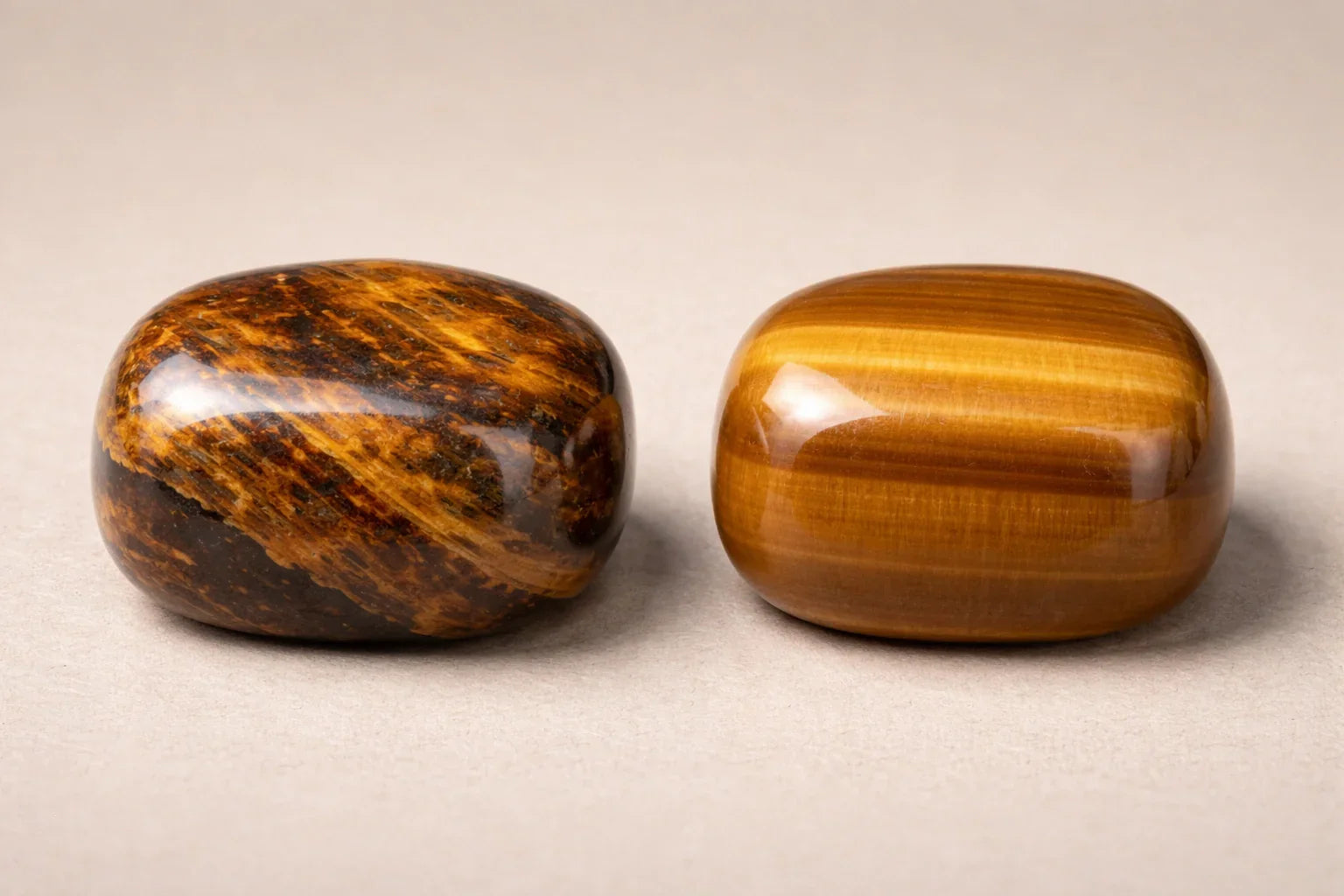
Tiger’s eye is one of the most appreciated natural stones. Its popularity is first based on its very distinctive visual appearance. This natural tiger’s eye stone features luminous bands, golden to brown reflections, and a shimmering effect that gives it an impression of movement. Depending on the angle of the light, the surface seems almost alive. It is precisely this uniqueness that makes it so appealing, whether as a tumbled stone, decorative object, or tiger’s eye jewelry.
But its popularity is not explained by its aesthetics alone. Tiger’s eye is also known for the symbolic values associated with it: courage, stability, concentration, self-confidence, and grounding. Many people turn to this stone as part of a personal development journey or simply because they appreciate the meaning it conveys. This dual dimension, both aesthetic and symbolic, reinforces its appeal.
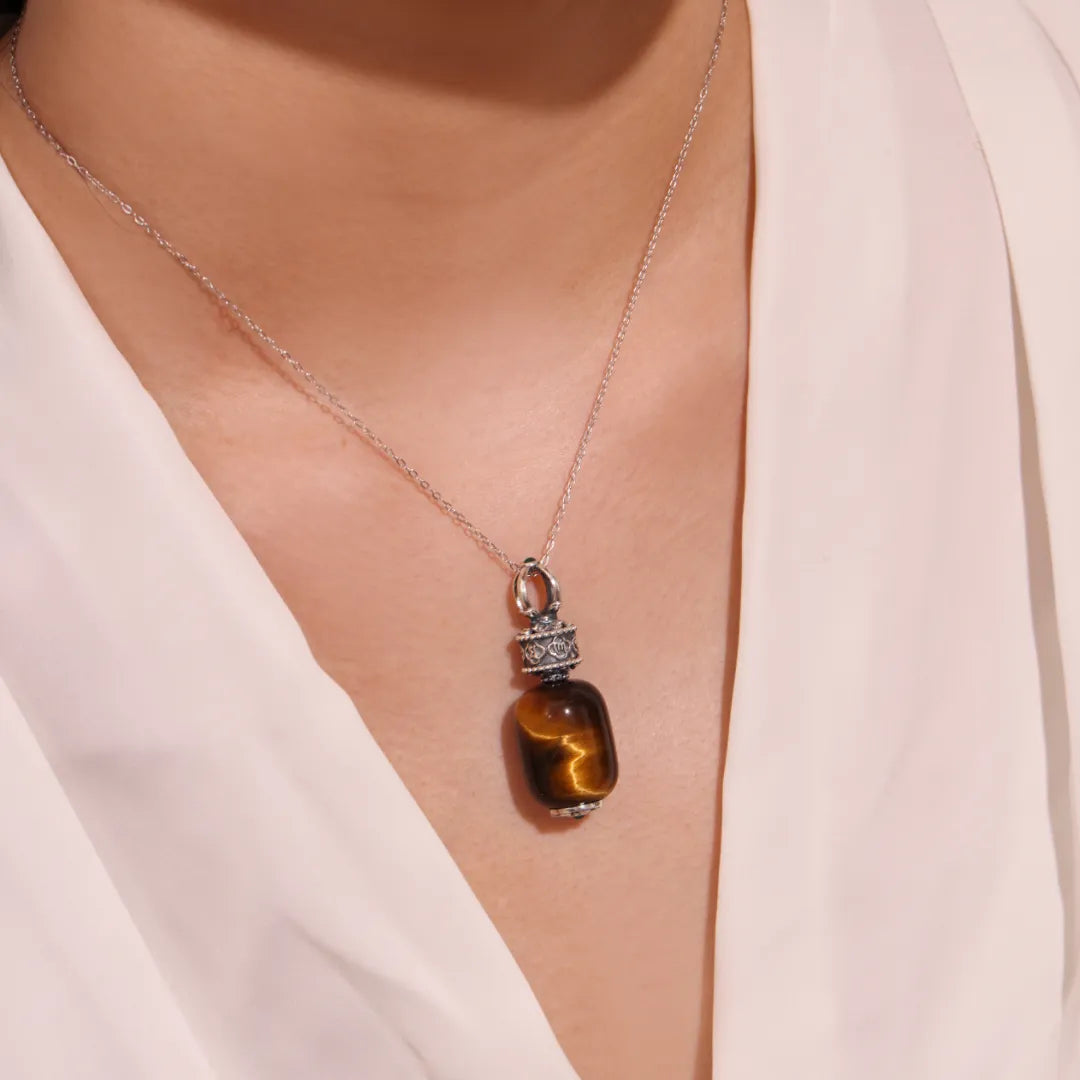
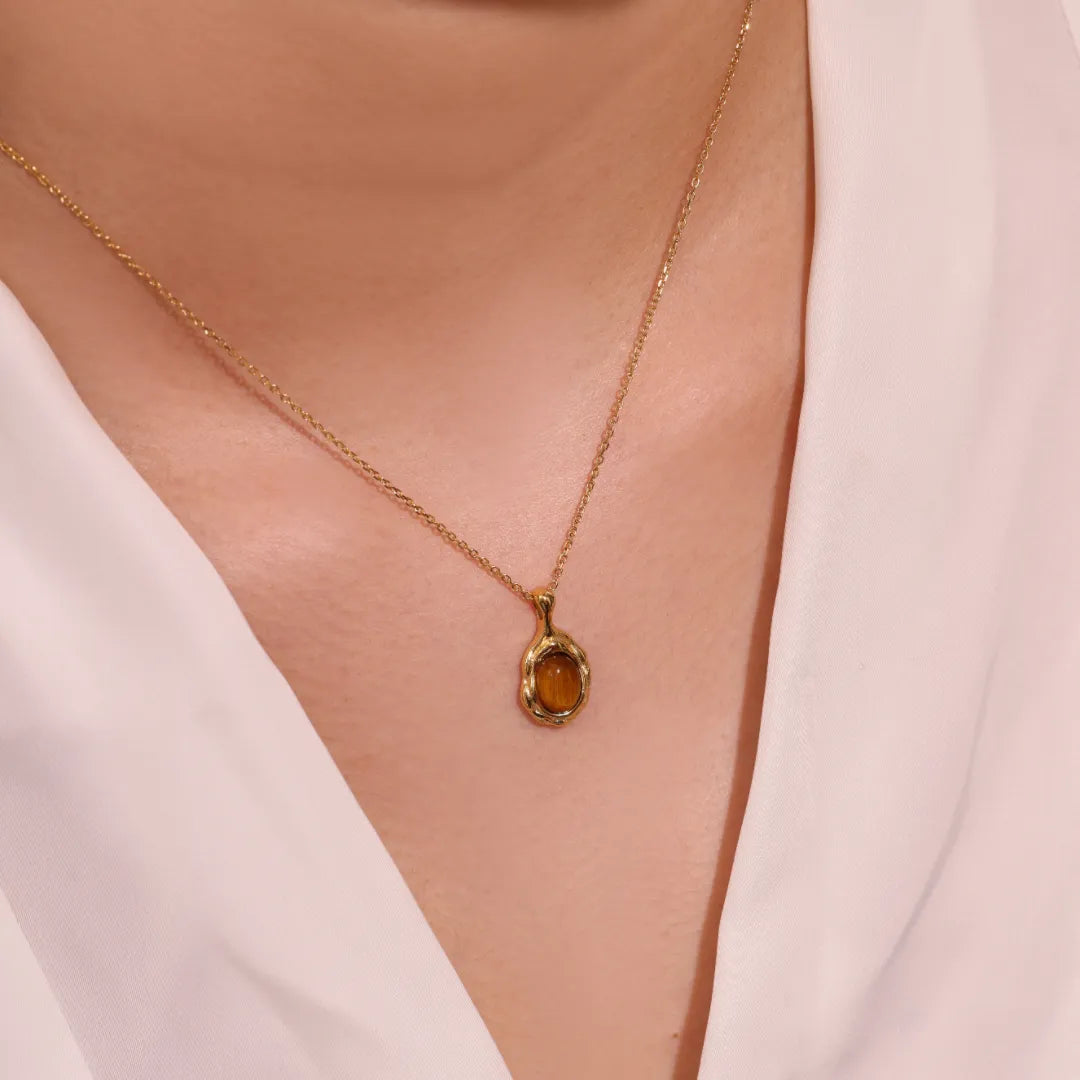
It is therefore easy to understand why the tiger’s eye jewelry market has grown so much. Bracelets, rings, pendants, and necklaces are now enjoying real popularity. And strong demand also means a multiplication of imitations.
To explore the symbolism of this stone further, you can read the article Tiger’s Eye: Stone of Strength and Self-Confidence.
Why there are so many imitations of tiger’s eye
The commercial success of tiger’s eye has naturally led to the appearance of many copies. Some are sold transparently as synthetic stones or decorative materials. Others, however, are presented as authentic stones when they are actually resin, colored glass, or dyed stones.
Why is tiger’s eye so often imitated? Quite simply because it has a strong visual identity but one that is relatively easy to reproduce in appearance. Brown and golden colors, a glossy polish, a more or less simulated banding effect: for an untrained eye, the illusion can work.
Fake stones are mainly found in:
- jewelry sold at very low prices
- certain general marketplaces
- shops with little specialization in natural stones
- products whose descriptions remain vague or overly commercial
Another point deserves to be emphasized: an imitation is not always crude. Some copies play precisely on the idea that the customer expects to see a “perfect” stone. But nature is never perfectly uniform. A real natural tiger’s eye stone often shows slight variations, more or less marked lines, subtle contrasts, and a depth that is difficult to reproduce artificially.
This is where careful observation becomes essential.

How to recognize a genuine tiger’s eye stone
Recognizing a genuine tiger’s eye stone does not rely on a single criterion, but on a combination of several consistent signs. The more clues you cross-check, the more reliable your assessment can be.
1. Observe the shimmering effect
Genuine tiger’s eye is famous for its shimmering effect, also called the “cat’s eye” effect. This optical phenomenon gives the impression that a luminous band glides across the surface of the stone when it is moved under the light.
On an imitation, this effect may appear fixed, too uniform, or artificially drawn. On a real stone, by contrast, the light seems to move subtly. The result is deeper, less flat, almost silky.
2. Examine the colors and their shades
A natural tiger’s eye stone displays natural color variations. It often includes:
- brown
- golden tones
- honey
- bronze
- sometimes darker areas
A stone that is too uniform, too visually smooth, or too “perfect” should raise suspicion. In nature, irregularities are often a good sign.
3. Check the internal structure
Even when polished, a real stone retains a fibrous or banded structure that contributes to its identity. The lines are not always strictly regular. They may be finer in one place and more diffuse in another. This visual complexity is part of its charm.
Imitations, on the other hand, often show:
- bands that are too symmetrical
- a repetitive pattern
- lack of depth
- a look similar to plastic or glass
4. Touch the stone
Touch also provides useful information. A natural stone generally feels cooler to the touch than a synthetic material. It also gives a stronger impression of density. While not absolute proof, this detail can confirm an initial visual impression.
5. Evaluate the weight
An imitation made of resin will often be lighter than a genuine mineral. Again, this is not an isolated criterion, but an additional clue. A stone that feels too light for its size deserves closer attention.
6. Analyze the price with common sense
A very low price does not necessarily mean fraud, but it should invite caution. A real natural tiger’s eye stone, well selected and properly set in jewelry, has a certain value. When a product is sold at a ridiculously low price while being presented as premium, doubt is legitimate.
7. Learn about the seller
This is often the most underestimated criterion. A trustworthy site highlights:
- precise descriptions
- detailed photos
- consistent information
- a specialized universe
- educational content about natural stones
In other words, recognizing a genuine tiger’s eye stone is not only about looking at the stone, but also about assessing the context in which it is being sold.
To discover pieces that showcase this gemstone, you can browse the Tiger’s Eye Jewelry Collections.
Common mistakes when trying to recognize a real tiger’s eye
Many buyers make the same mistakes when faced with a stone presented as authentic. Yet these reflexes can lead to wrong conclusions.
Relying only on color
Just because a stone is brown and golden does not necessarily mean it is a genuine tiger’s eye. An imitation can reproduce the color palette quite easily. The real difference often lies in the depth, reflections, and structure.
Thinking a perfect stone is more authentic
This is a very widespread idea. Yet natural stones are not industrial objects. They often show small irregularities, tonal variations, or less smooth areas. That is precisely what gives them their identity. A stone that is too uniform may be more suspicious than a slightly imperfect stone.
Confusing shine with quality
A very shiny appearance is not always a guarantee of authenticity. Glass and resin can also shine strongly, sometimes even more than a natural stone. It is therefore important to distinguish surface shine from mineral depth.
Ignoring the quality of the jewelry setting
In the world of tiger’s eye jewelry, the setting, finishes, and consistency of the product also matter. A piece of jewelry that highlights a supposedly natural stone but whose overall look seems low-end may raise questions about the authenticity of the material.
To go further in the relationship between aesthetics and symbolism, you can read Tiger’s Eye Jewelry: Elegance and Energy.














Why authenticity also matters for the benefits attributed to tiger’s eye
When people take an interest in natural stones, they are not just looking for a beautiful object. They are often looking for a more complete experience. This may be an attraction to minerals, an interest in traditions, or a sensitivity to the virtues attributed to stones.
In this context, authenticity takes on a central place. An imitation may be decorative, but it does not meet the same expectation as a natural stone. For people interested in the benefits of tiger’s eye, it seems logical to favor a genuine stone from the mineral world rather than an artificial material.
Tiger’s eye is often associated with several symbolic dimensions:
- self-confidence
- protection
- grounding
- determination
- clarity in decision-making
These are precisely the expectations that lead many buyers to want to recognize a genuine tiger’s eye stone before making their choice. Because when you choose a stone for what it represents, the question of authenticity becomes even more important.
To better understand this dimension, you can read Benefits and Properties of Tiger’s Eye.

Tiger’s eye and emotions: why a real stone makes the difference in the buying experience
The link between tiger’s eye and emotions interests more and more readers. In a sometimes hectic daily life, some people look for objects full of meaning, capable of supporting a personal intention: regaining calm, strengthening confidence, getting through a period of doubt more easily, or simply reconnecting with themselves.
In this approach, choosing a real natural stone often makes more sense than choosing an imitation. Not because a copy would be useless decoratively, but because people do not project the same meaning onto a synthetic material as onto an authentic mineral shaped by nature.
Tiger’s eye is frequently chosen by people who want to regain a form of emotional stability or strengthen their inner confidence. Simply knowing that one is wearing a natural stone can already contribute to the symbolic value of the jewelry. This detail matters greatly in the relationship one has with the object.
This is also why tiger’s eye jewelry is so successful: it combines style, visual presence, and personal meaning. Provided, of course, that the stone is real.
On this subject, you can read The Effects of Tiger’s Eye on Stress and Emotions.
Where to buy a genuine tiger’s eye without making a mistake
Buying a real stone requires less luck than method. To avoid disappointment, a few simple habits can make all the difference.
The right things to look for before buying
- choose a shop specialized in natural stones
- read the product sheet carefully
- check the consistency of the photos
- observe whether the seller shares educational content
- compare several options before choosing
- avoid promises that seem too good to be true
Signs of a trustworthy website
A reliable seller does not only try to sell. They explain, provide context, and guide. When a website offers in-depth articles about natural stones, their uses, their specificities, and their meanings, this generally inspires more confidence than a shop with descriptions that are too brief.
It is also useful to observe how the jewelry is presented. A tiger’s eye jewelry specialist will speak about the stone precisely, and not only in commercial terms.
Conclusion
Recognizing a genuine tiger’s eye mainly requires careful observation and a few good reference points. A real natural tiger’s eye stone stands out through its shimmering effect, its non-uniform shades, its lively structure, its density, and the authenticity of the context in which it is sold. By contrast, imitations often have an appearance that is too perfect, too shiny, or too uniform.
In the world of natural stones, learning to recognize a genuine tiger’s eye stone is a useful approach, whether you are buying for beauty, symbolism, or for the benefits of tiger’s eye that are often sought after. This vigilance helps you make a more informed, more lasting, and more consistent choice aligned with your expectations.
Finally, when one is interested in tiger’s eye and emotions, its place in jewelry, or its protective dimension, authenticity becomes far more than a technical detail: it becomes part of the experience.
How can you recognize a genuine tiger’s eye stone?
A genuine tiger’s eye stands out through its shimmering reflections, its natural shades of brown and gold, and its fibrous structure visible under the light.
Can an imitation tiger’s eye look like a real stone?
Yes, some imitations made of glass, resin, or dyed stone may seem convincing at first glance, but they often lack depth and natural variation.
Is a stone that is too shiny necessarily fake?
Not always, but a shine that is too uniform or too “plastic-looking” can be a sign of imitation. You should also observe the reflections and texture of the stone.
Does the price help determine whether a tiger’s eye stone is real?
The price can provide a clue, especially if it is unusually low, but it is not enough on its own to confirm authenticity.
Why choose a natural tiger’s eye stone rather than an imitation?
A natural stone offers more authentic beauty, unique reflections, and stronger symbolic value for people who feel connected to natural stones.
Read more

Discover the benefits and virtues of tiger’s eye, a natural stone renowned for protection, self-confidence, and emotional balance. This article also explores its connection with emotions, its every...

Tiger’s eye jewelry captivates with its natural elegance and strong symbolism. This natural stone is appreciated for its unique reflections, its supposed benefits, and its connection to self-confid...


