

Natural or Treated Labradorite: How to Recognize an Authentic Stone
- Introduction
- Understanding labradorite: natural, treated… and everything in between
- The most common treatments: what to look for (and why it matters)
- The 7 most reliable visual signs to recognize an authentic labradorite
- Simple at-home tests (without damaging the stone)
- Labradorite and lithotherapy: natural vs treated—does it change anything?
- Buying authentic labradorite: the anti-disappointment checklist
- Labradorite jewelry: how to spot quality without getting it wrong
- Caring for natural labradorite: preserve the shine without harming it
- Conclusion: recognizing authentic labradorite is mostly about learning to observe
- FAQ — Natural or treated labradorite: your most useful questions
Introduction
Buying a labradorite is often love at first sight. You see it shimmer, you can already picture it as a pendant, a ring, or sitting on a shelf like a mini aurora borealis. And then a question comes up (often after the purchase, let’s be honest): is it a Natural Labradorite, or a treated Labradorite? In the natural stones market, labradorite is highly appreciated… so inevitably, it gets heavily “optimized” by some less-than-scrupulous sellers.
In this article, we’ll keep it simple and complete: understand what sets an authentic natural labradorite stone apart from a treated stone, spot visual clues, learn the most common treatments, do non-destructive at-home tests, and buy with more peace of mind. We’ll also talk about lithotherapy, the benefits of labradorite and the properties of labradorite, with an important note: lithotherapy is a wellness approach and does not replace medical advice.
Goal: so you can look at a labradorite and say with confidence, “I know what I’m seeing.”
Our Labradorite Jewelry
Understanding labradorite: natural, treated… and everything in between
What do we mean by “natural labradorite”?
A Natural Labradorite is a stone (a plagioclase feldspar) formed naturally, then mined, cut, and polished. It hasn’t been chemically modified to change its color or structure. That doesn’t mean it’s “perfect”: on the contrary, natural stones almost always show small irregularities (micro-inclusions, more opaque areas, shade variations). It’s even one of the most reassuring signs.
What makes labradorite unique is its labradorescence: a play of colors that appears when light reflects within internal lamellar structures. The effect can be blue, green, golden, sometimes coppery. And yes, sometimes also… subtle. A labradorite can be authentic without being a disco ball.
What is a “treated labradorite”?
A treated Labradorite is a stone that has undergone an intervention intended to improve its appearance (color, shine, uniformity, stability). Treatments exist for many gemstones and minerals; the real issue isn’t always the treatment itself, but the lack of transparency.
In the natural stones world, the line can be blurry for the general public. High-quality polishing isn’t a “misleading treatment”: it’s a normal finishing step. Dyeing, surface coating, resin impregnation, heating, or stabilization should ideally be disclosed.
Why are some labradorites treated?
Three main reasons:
- Boost the visual effect : an “average” labradorite can become “wow” in photos.
- Even out the color : especially to meet an expectation of perfection.
- Hide weaknesses : cracks, porosity, dull areas.
Key takeaway: an authentic natural labradorite rarely looks uniform across the entire surface. Nature makes beautiful things, but it doesn’t have a “smoothing” filter.
Read next: Labradorite: Stone of Protection and Intuition

The most common treatments: what to look for (and why it matters)
To recognize a treated Labradorite, you first need to know the methods used. Here are the most common ones, along with the “clues” they tend to leave behind.
Dyeing: color that seeps in where it shouldn’t
Dyeing involves forcing colorants into the stone, often through cracks or more porous zones. It’s not always obvious to the naked eye on a polished surface, but certain details give it away: overly uniform color, concentrated areas near micro-cracks, traces around drill holes (jewelry), or buildup along edges.
The classic trap: a labradorite that is unnaturally “electric blue” everywhere, with no resting zones, no variation, and at a surprisingly low price.
Surface coating: the too-perfect “mirror” effect
Some stones receive a film or layer (sometimes called a coating) that amplifies the iridescence. The result can be very dramatic… but sometimes “flat,” as if the effect sits on the surface instead of coming from within.
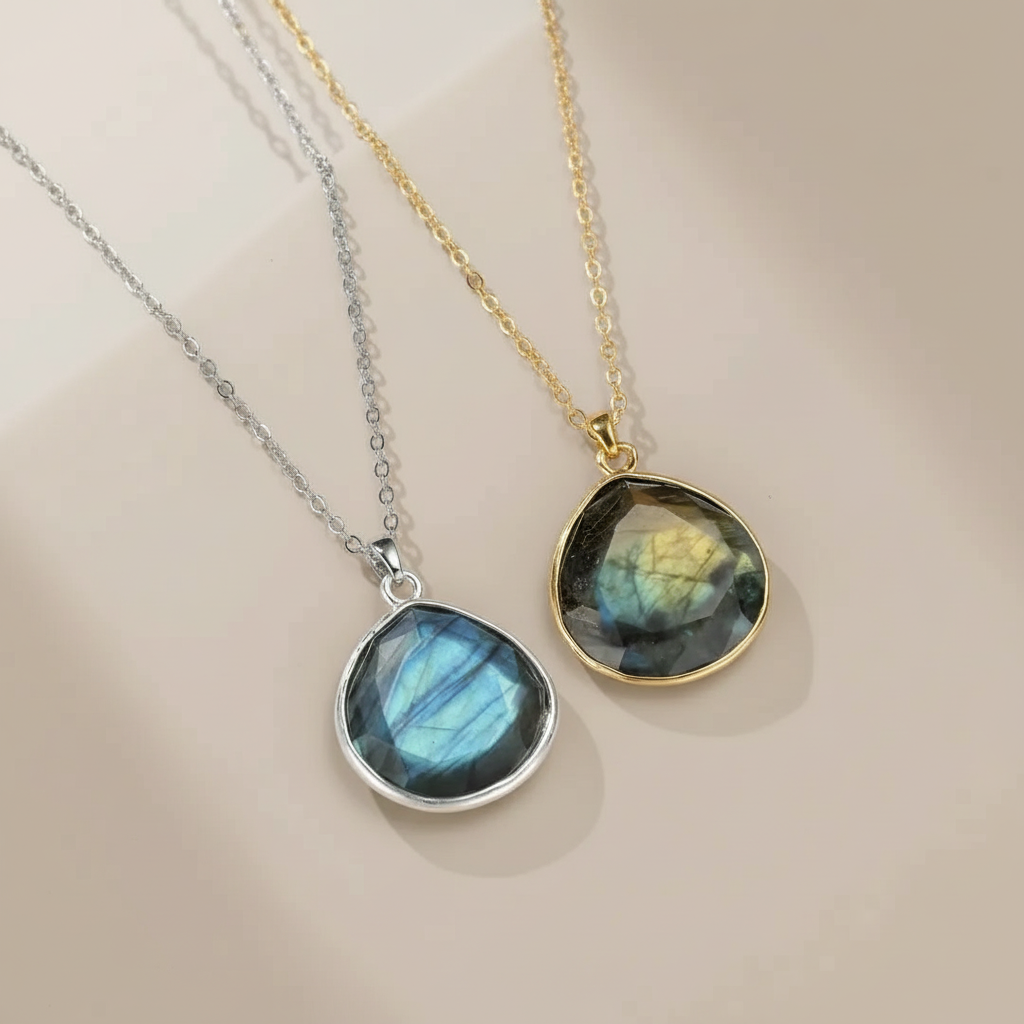
Typical clue: the reflection is too uniform and stays the same no matter the angle. Natural labradorescence “lives”: it appears, disappears, and shifts depending on the light.
Resin impregnation: a “reinforced” stone
For cracked or fragile stones, a transparent resin can be injected. This can stabilize the stone, but it can also mask fractures and create a slightly “plastic” shine. With labradorite, it’s less common than with other stones, but it does happen, especially in very low-cost ranges.
Possible clues: excessive shine, a “varnished” feel, tiny bubbles (rare), and sometimes a slight chemical smell in a new stone (not systematic).
Heat treatment: intensifying certain effects
Heat treatment is better known for other gemstones, but practices exist in the decorative mineral market. It can alter appearance or enhance certain tones. For labradorite, it’s less “standardized,” which makes it harder to detect without equipment. Still, if the stone shows an unusually uniform or unusual color, it’s worth asking the question.
Stabilization: improving the durability of a lower-grade stone
Stabilization reinforces a porous or fragile stone. Labradorite isn’t among the most porous natural stones, but lower-quality lots can be stabilized to reduce breakage.
Important point: a treatment isn’t always a “lie.” The problem is when a stone is sold as “100% natural untreated” without proof, while the clues suggest otherwise.
The 7 most reliable visual signs to recognize an authentic labradorite
This is where things get practical. You don’t need to be a gemologist—just methodical. The idea: observe, compare, and look for what’s consistent with a Natural Labradorite.
Labradorescence should feel “deep,” not “painted on”
An authentic stone often gives the impression that light comes from within. The iridescence appears like an inner layer that reveals itself depending on the angle. With a treated Labradorite coated on the surface, the effect can look “on top,” like metallic paint.
Tip: rotate the stone slowly. On a natural labradorite stone, the flash moves, breaks up, intensifies, then fades. On a treated stone, the flash can remain too constant.
Color distribution: nature loves irregularity
An authentic labradorite often has:
- very bright areas,
- other grayer areas,
- transitions that aren’t perfectly symmetrical.
A stone that’s too uniform—especially across a whole collection of identical products—deserves a closer look.
“Calm” areas aren’t a flaw—they’re a clue
You often see disappointed people: “my labradorite isn’t shiny everywhere.” And that’s normal. Many labradorites have one side that’s more active than the other, or zones that are less iridescent. A stone that’s “too perfect” can be the result of extreme selection… or treatment.
Micro-inclusions: the signature of natural stones
Tiny internal clouds, lines, micro-impurities: in most cases, that’s reassuring. Note: we’re not talking about large fractures that weaken the stone, but those small internal marks that remind you the stone has a geological history.
Cracks: telling natural fractures from filling/cover-ups
A natural crack is often internal, irregular, with variations. A “filled” crack can look smoother, with a uniform glassy appearance. If everything feels overly “varnished,” resin is possible.
Edges and drill holes: dye’s favorite spot
If you have a piece of jewelry (or a drilled stone), look around the hole. Dye tends to concentrate there. On a cut stone, inspect the edges: if color builds up in tiny grooves, that’s suspicious.
Shine: normal polish vs “plastic” shine
A well-polished labradorite is shiny, yes. But it often retains mineral depth. A shine that’s too uniform and “mirror-like” over the whole surface—especially if the iridescence is also too regular—can indicate a coating.
A simple rule: the more “perfect” it looks, the more you should observe. Natural stones don’t try to be perfect—they try to be themselves.
Simple at-home tests (without damaging the stone)
Forget anything that scratches, burns, or “tests hardness with a knife.” Labradorite deserves better. Here are gentle, useful, realistic tests.
Test 1: raking light (the most telling test)
What you need: a lamp (or your phone flashlight) and a not-too-bright place.
- Place the light to the side, almost horizontally.
- Rotate the stone slowly.
- Observe how the labradorescence appears.
A Natural Labradorite will show changing flashes, sometimes in “plates” that move. A Labradorite treated with a film may create a more constant, more superficial effect.
Bonus: do the same test with warm light (bulb) and then cool light (LED). A natural stone often changes character depending on color temperature.
Test 2: an unfiltered photo (and comparing it to reality)
Many “incredible” stones are mostly… incredible in heavily saturated photos. Take a photo of your stone:
- with no filter,
- in daylight (near a window),
- then under a lamp.
Compare it with the seller’s photos. If your stone suddenly looks very different, it isn’t always fraud (photos vary), but it’s a signal to keep in mind.
Test 3: a slightly damp cloth (detecting dye residue)
Take a clean white cloth, dampen it very slightly, and gently rub an inconspicuous area (without scrubbing).
- If there’s a colored trace, that’s a major red flag.
- If there’s nothing: it doesn’t prove there’s no treatment, but it’s reassuring.
Important: no solvents, no alcohol, no household cleaners.
Test 4: looking at micro-details with a loupe (optional but very effective)
A small 10x loupe (inexpensive) can help you spot:
- bubbles (coating/resin),
- pigment buildup in cracks,
- a surface layer.
It’s not “mandatory,” but it’s the test that often makes the difference between intuition and certainty.

Labradorite and lithotherapy: natural vs treated—does it change anything?
Let’s be honest: people who buy a natural labradorite stone often do it for two reasons—beauty and lithotherapy. Labradorite is known for its properties linked to protection, intuition, and emotional balance. The benefits of labradorite are often described as support during periods of social fatigue, mental overload, or when you tend to “absorb” other people’s energy.
The benefits and properties of labradorite: what’s most commonly said
In lithotherapy, Natural Labradorite is frequently associated with:
- a feeling of energetic protection,
- better emotional grounding,
- support for intuition and mental clarity,
- a boost of vitality when you feel “drained.”
Of course, this remains a wellness approach. If you have a health issue, keep the right reflex: healthcare professional first.
Treated stone: impact on lithotherapy?
There are two viewpoints.
- “Material” viewpoint : some treatments (coating, resin) add an artificial layer that may bother those seeking the rawest possible contact with the stone.
- “Symbolic/energetic” viewpoint : in many lithotherapy traditions, the most natural stone possible is considered preferable, because it hasn’t been modified in its “expression.”
Practical conclusion: if lithotherapy is central for you, prioritize a clearly disclosed Natural Labradorite, with a serious selection. If your goal is mostly aesthetic, a treated stone (disclosed as such) can work—as long as it’s transparent and the price makes sense.
Read next: Benefits and Properties of Labradorite

Buying authentic labradorite: the anti-disappointment checklist
You can know every clue in the world… and still get fooled if you buy from the wrong place. Here’s a simple, useful checklist focused on “smart buying.”
The right questions to ask (even if you don’t dare)
- Is the stone natural, or has it undergone a treatment (dyeing, coating, resin)?
- Is the origin known?
- Are the photos taken in natural light, without filters?
- Can I see a video of the stone rotating (especially for labradorite)?
- What is the return policy?
A serious seller shouldn’t be offended. On the contrary: they’ll be glad you’re buying with full awareness.
Watch out for words that blur everything
On some product pages, you’ll read:
- “premium quality”
- “exceptional effect”
- “rare stone”
… with zero info about treatments.
Flattering wording doesn’t replace a clear description.
Price: an indicator, not proof
A Natural Labradorite with a strong flash can be more expensive. But a high price isn’t a guarantee of authenticity, and a low price isn’t automatically fraud. The real signal is the gap: a “spectacular” stone at an ordinary-stone price should push you to verify.
For jewelry: also look at the setting
A beautiful natural labradorite stone can be poorly showcased if:
- the setting hides the flash zone,
- the stone is oriented the wrong way,
- the surface is too exposed to knocks (a very high ring, for example).
Orientation is essential: labradorite is also chosen for its “life angle,” meaning the angle at which it best reveals its labradorescence.
Discover: Labradorite Jewelry Collections
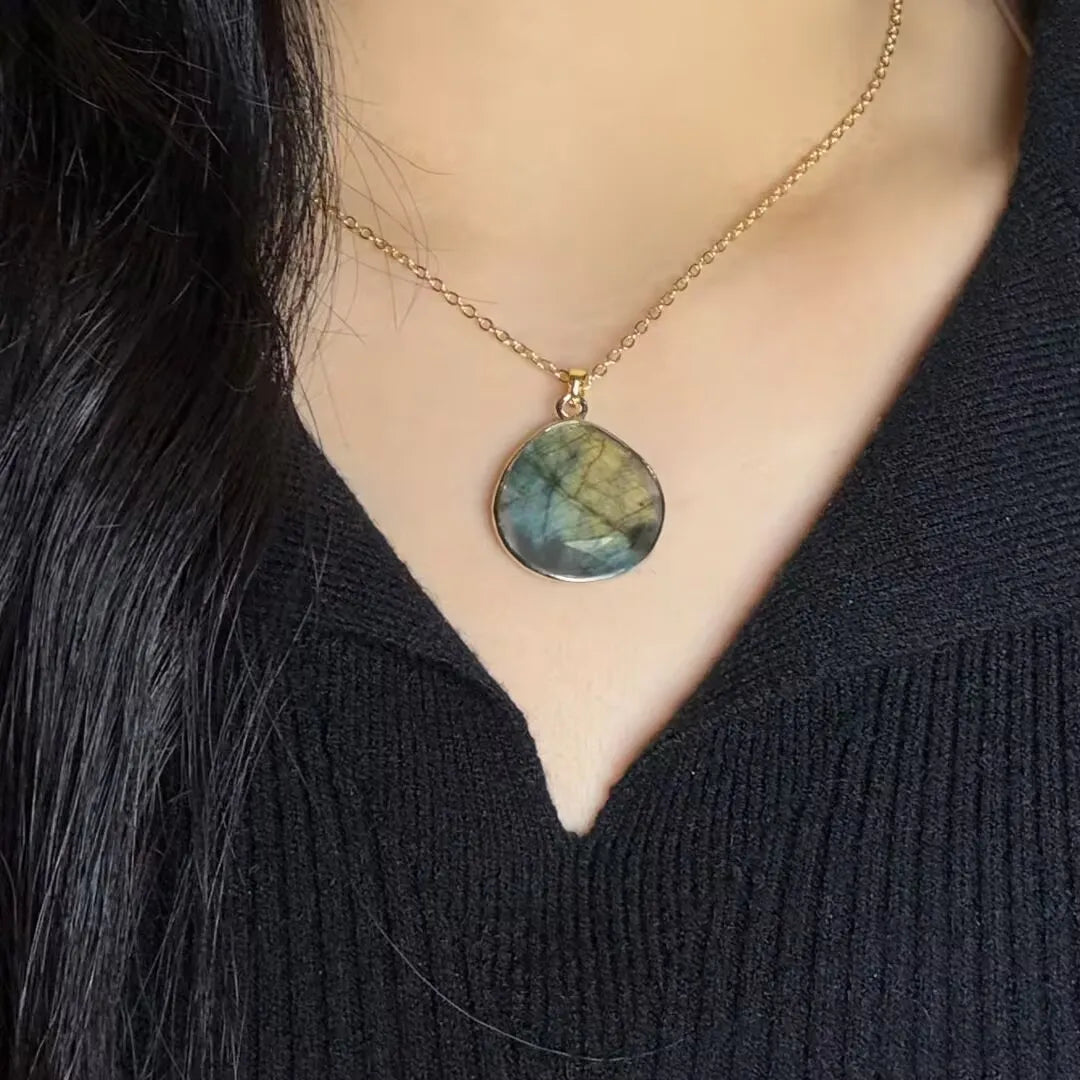
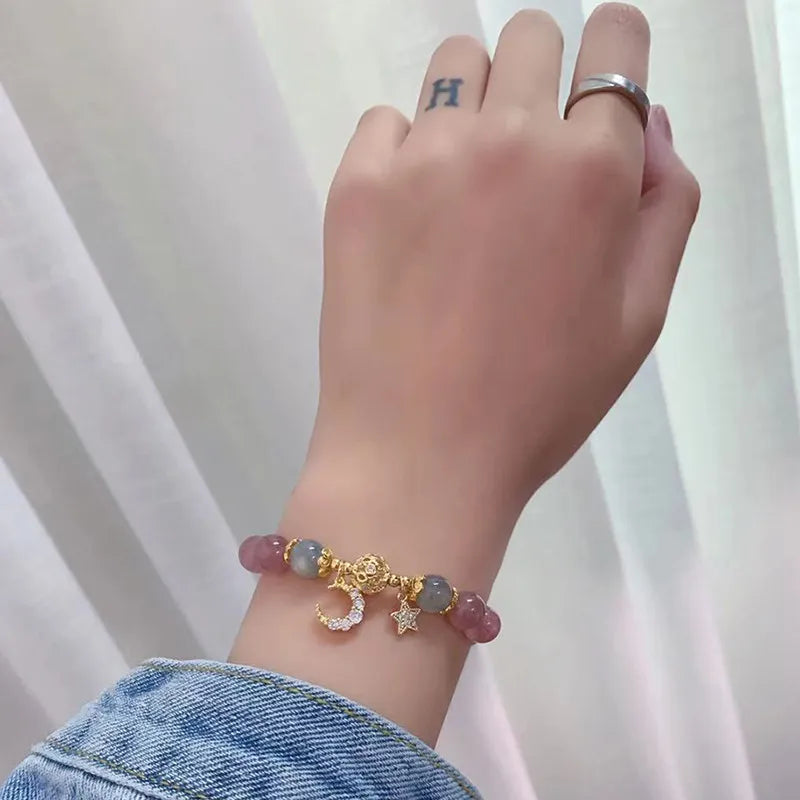
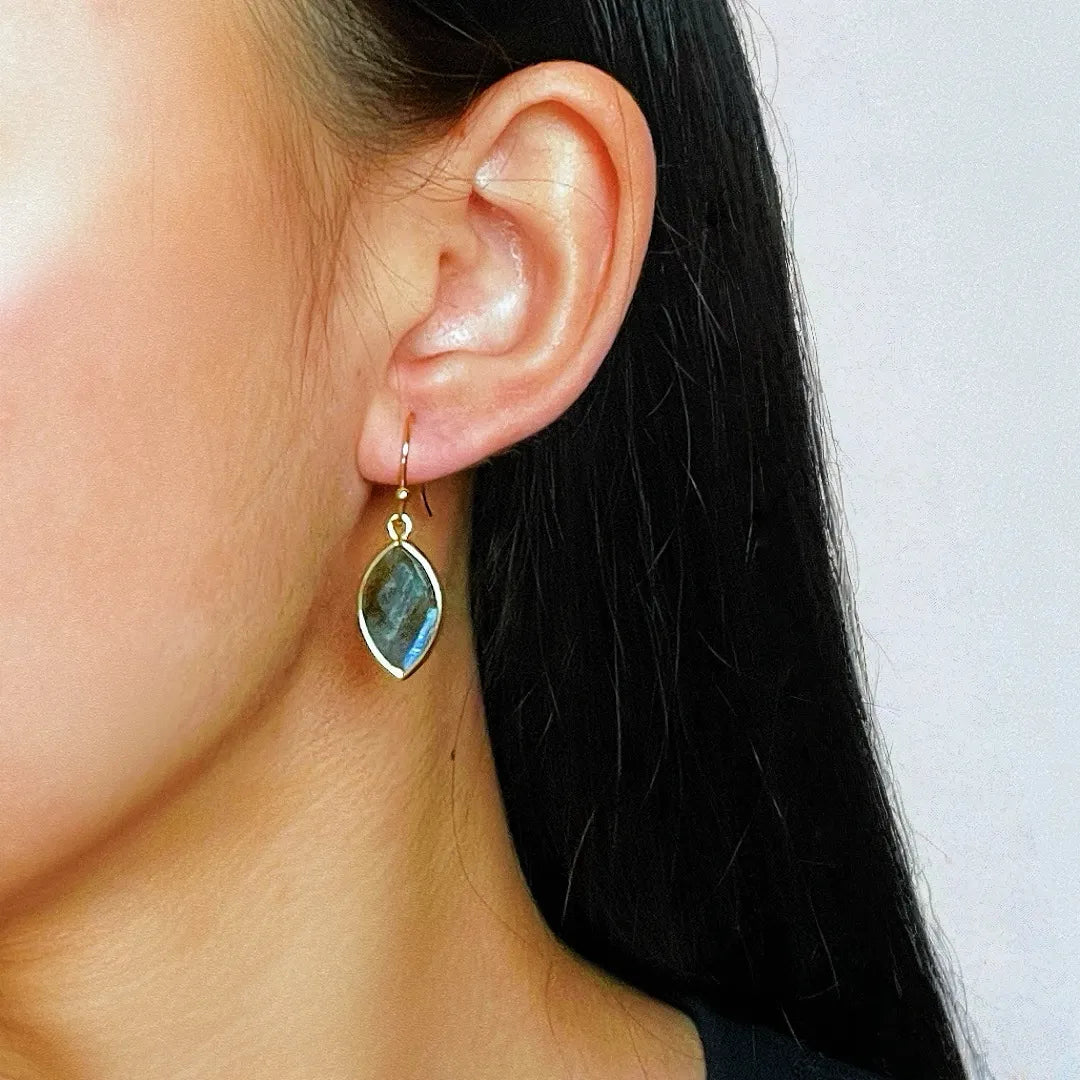
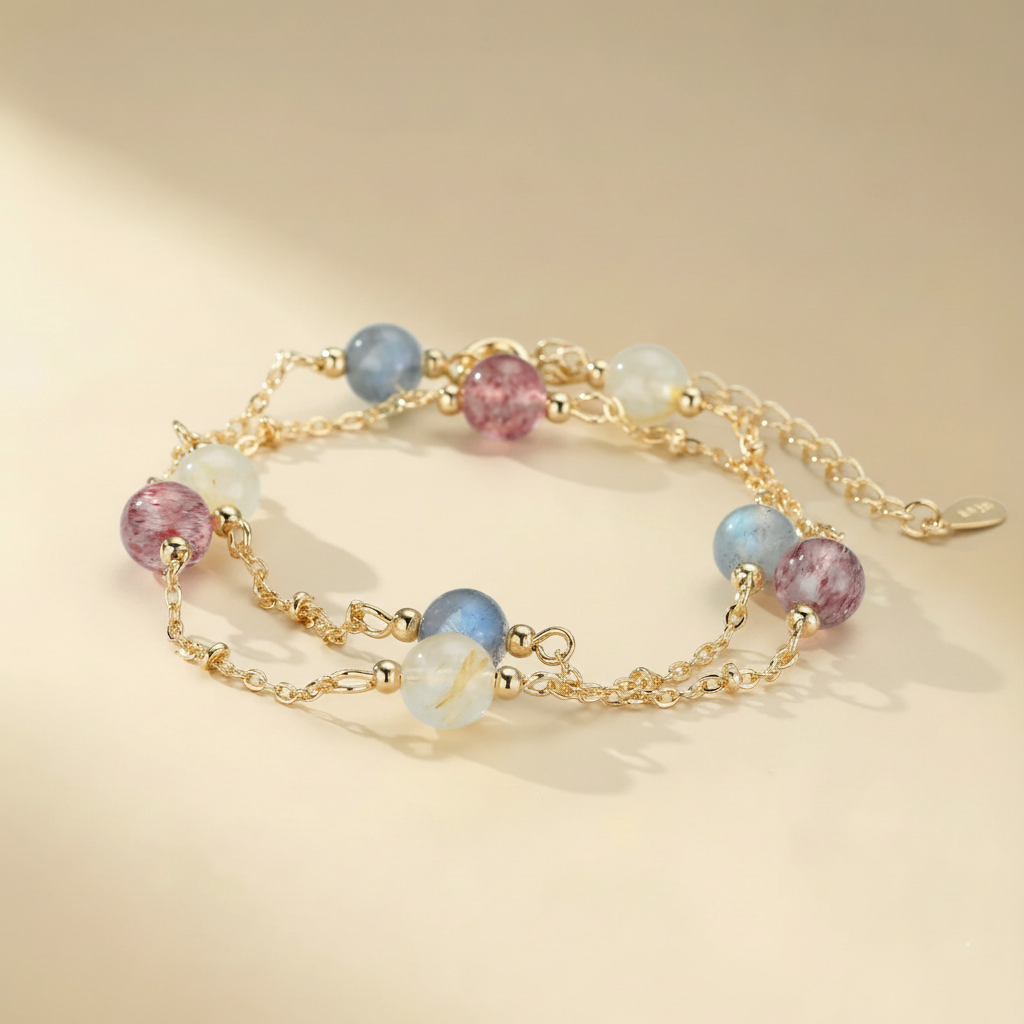
Labradorite jewelry: how to spot quality without getting it wrong
Choosing labradorite as jewelry takes things up another level: you don’t just have the stone—you also have the cut, polishing, orientation, and everyday durability.
Cut and polish: more important than you think
Two natural labradorites can have similar labradorescence potential, but:
- one will be cut to catch the light,
- the other will be cut “flat” and look dull.
Good polishing reveals depth. Overly aggressive polishing can create misleading shine, but careful polishing enhances without distorting.
Orientation: the secret of stones that “light up”
Labradorescence depends on angle. A stone can be authentic and still disappoint if it’s set in a direction that doesn’t present its best flash to the eye.
When possible, prioritize jewelry that shows a photo/video “in motion,” because labradorite is a dynamic stone.
Durability: a stone to respect
Labradorite isn’t the most fragile of natural stones, but it can scratch or crack with impact. For everyday wear:
- pendants and earrings are often “safer,”
- rings require more care (doors, keyboards, drops).
Read next: Labradorite Jewelry: Elegance and Energy






Caring for natural labradorite: preserve the shine without harming it
A Natural Labradorite, when well cared for, keeps its reflections for a long time. Maintenance is also a good “indirect test”: a treated stone sometimes reacts differently to cleaning (though not systematically).
Simple (and effective) cleaning
- Lukewarm water
- Mild soap (optional)
- Soft cloth or very soft brush
- Gentle drying
Avoid:
- ultrasonic cleaners,
- chemicals,
- direct salt,
- sudden temperature changes.
Storage: the detail that changes everything
Store your stone or jewelry separately, ideally in a soft pouch. Labradorite can scratch when it comes into contact with harder stones.
Lithotherapy: cleansing and recharging (if you practice)
Methods vary depending on beliefs and habits. Many people favor gentle approaches. The essential thing: avoid anything that could damage the stone or its polish.
Conclusion: recognizing authentic labradorite is mostly about learning to observe
To tell Natural Labradorite from treated Labradorite, you don’t need a lab: you need a good eye and a bit of method. An authentic natural labradorite stone is often recognized by deep, shifting labradorescence, natural variations, a few micro-inclusions, and a less “perfect” but more believable beauty.
If you’re buying for lithotherapy, the benefits of labradorite and the properties of labradorite are often associated with protection and intuition, and many enthusiasts prefer untreated natural stones to stay as close as possible to the material.
And if you want to go further: ask for details, look for photos in motion, and buy from transparent sellers. Labradorite is already a spectacular stone. It doesn’t need a disguise.
How can you recognize a natural labradorite at first glance?
A Natural Labradorite shows “deep” labradorescence that changes with the angle, with calmer zones and sometimes small inclusions. A stone that’s too uniform and too perfect should raise a red flag.
Why does my natural labradorite sometimes look gray?
That’s normal: labradorescence depends on orientation and light. Rotate the stone under a lamp or near a window, and the effect often appears from just one “good” angle.
Is a very shiny labradorite necessarily treated?
No. Good polishing can make it shiny. What’s suspicious is a “plastic” shine combined with an iridescent effect that’s too regular, as if laid on the surface.
How can you spot dye on a labradorite?
Look at the edges, micro-cracks, and especially around drill holes (if it’s a bead or jewelry). Color tends to concentrate there. A slightly damp white cloth can sometimes reveal residue.
What simple at-home test can you do to check authenticity?
The best test is raking light: shine a light from the side and rotate the stone slowly. A Natural Labradorite lights up and fades in zones, with a living effect.
Read more

Discover the benefits and properties of Labradorite, an essential natural stone in crystal healing. Known for its energetic protection, emotional support, and intuitive power, Labradorite captivate...
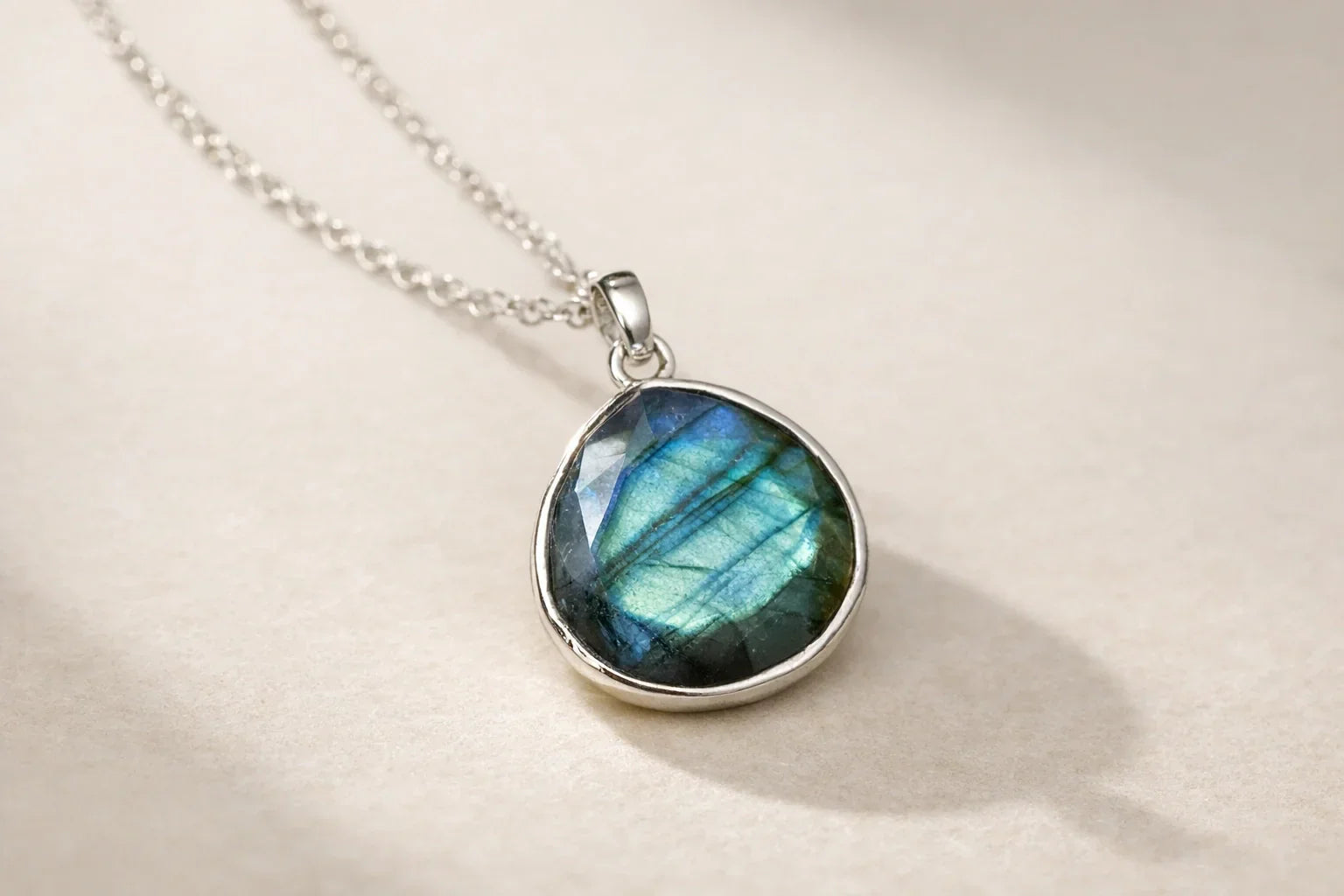
Discover why labradorite is one of the most fascinating natural stones, admired for both its elegance and its unique iridescent flashes. This article guides you in choosing your labradorite jewelry...


